Welcome

Check every section from this blog and take your time to use the commentaries to help to improve it. Thank you!


Showing posts with label Superstitions. Show all posts

Thursday, November 28, 2013

Friday 13th by Bryan

FRIDAY 13th
My relationship with the superstition isn't very good because I didn't believe in it because it seems unreal to believe that Friday 13th is a bad day.

People believe that the day Friday 13th is a bad day because those horror movies which have that title, there are also people who think Tuesday13th is another bad day and I wonder Why? 

For me that is a normal day and I haven't got fear of anything or anyone. Normally the number 13 has a bad reputation because that day is the day that Jesus died. It also has to do with the Templar Knights since they were captured and charged with crimes against Christianity. This led them to death or a bonfire that eventually caused its disapperance.

In conclusion I don't believe in any superstition that friday 13th is a day of bad luck for the death of Jesus and that of the Templars.


Tuesday, November 12, 2013

Superstition in Spain by Mikel itoiz

 
In Spain people belive in a lot of superstitions and in this writing I am going to explain some superstitions.

A famous superstition is to break a mirror. It is a symbol of unlucky for seven years.
Other people think that the yellow colour is unlucky and they don´t wear clothes of that colour.

I am superstitious because I touch wood when I don´t want bad luck. In my family the favourite superstition is to eat twelve grapes on New year´s Eve. My family thinks that this superstition brings good luck.

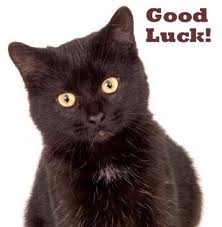
Another superstition is seeing a black cat. if the cat comes to you, you will have good luck  but if the cat gets away from you, you´ll have bad luck.

These are the most famous superstitions in Spain.

Friday, January 13, 2012

Friday the 13th, The end of the world!

Hello!This is a former article, but I decided to republish it due to the fact that today is the first Friday 13th of the supposed last year of the world: 2012!

Friday the 13th myth makers

Watch out for black cats, avoid mirrors and ladders and, by all means, don't spill the salt.

As most people probably already realize, today is Friday the 13th, a date commonly associated with bad luck.

For the next several hours, millions of superstitious individuals across the country will hold their breath anticipating misfortune. Others will avoid leaving the house altogether, refusing to drive, shop or work on the ill-fated day.

But whether you're a true triskaidekaphobe (a person with an irrational fear of Friday the 13th, also called a paraskevidekatriaphobe) or just mildly suspicious, it's probably a good idea to know just where your trepidation comes from.

Though it's hard to pinpoint the exact origins of any superstition, several Internet sites are devoted to the history of the Friday the 13th legend. And most list the same possible origins of the rumoured curse. One of the more lucid sites is David Emery's urbanlegends.about.

According to the site, the superstition is derived from myths about both Fridays and the number 13.

Fridays, for example, are hailed as a particularly significant day in the Christian tradition. Obviously, there is Good Friday, the day Jesus Christ was crucified. But according to Christian lore, Adam and Eve also supposedly ate the forbidden fruit on a Friday, the Great Flood started on a Friday, the builders of the Tower of Babel were tongue-tied on a Friday and the Temple of Solomon was destroyed on a Friday.

Of course, the Bible doesn't specifically note many these events occurring on Fridays, and Emery explains some of the tradition may have stemmed from the fact that pre-Christian pagan cultures hailed Friday as holy days. The word "Friday" is, in fact, derived from a Norse deity who was worshipped on the sixth day of the week and who represented marriage and fertility. Fridays in the early Norse culture were associated with love and considered a good day for weddings.

Over time, however, mythology transformed the Norse fertility goddess into a witch, and Fridays became an unholy Sabbath. Incidentally, the goddess' sacred animal was a cat, which may explain the legendary connection between witches and cats, as well as the superstition about black cats heralding bad luck.

In addition to the legendary significance of Fridays, the sixth day of the week also was execution day in ancient Rome and later Hangman's Day in Britain, according the Emery's Web site.

The number 13 also has mythological and religious symbolism.

Both the Hindus and Vikings reportedly had a myth in which 12 gods were invited to a gathering and Loki, the god of mischief, crashed the party and incited a riot. Tradition in both cultures holds that 13 people at a dinner party is bad luck and will end in the death of the party-goers.

Following in that vein, the Last Supper in Christian tradition hosted 13 people and one betrayed Christ, resulting in the crucifixion.

The number 13 also has been associated with death in other cultures. The ancient Egyptians, for example, believed life unfolded in 12 stages, and the 13th stage was death. The Egyptians considered death a part of their ultimate journey and looked forward to the spiritual transformation ‹ thus 13 was not an unlucky number in their culture ‹ but like so many others, the tradition warped through time and cultures, eventually associating the number 13 with a more negative and fearful interpretation of death, Emery writes.

Finally, Emery suggests the number 13 may have an unlucky connotation because of its association with the lunar calendar (there are 13 lunar cycles in a year) and with femininity (women have 13 menstrual cycles in a year).

Then, there's the event that ties the two superstitions together.

"Though it's clear that superstitions associating Fridays and the number 13 with misfortune date back to the ancient times, some sources assign the precise origin of the black spot on the day itself, Friday the 13th, to a specific historical event," adds Emery.

It was on Friday, Oct. 13, 1307, that France's King Philip IV had the Knights Templar rounded up for torture and execution. The Knights Templar were an order of warriors within the Roman Catholic Church who banded together to protect Christian travellers visiting Jerusalem in the centuries after the Crusades. The Knights eventually became a rich, powerful ‹ and allegedly corrupt order within the church and were executed for heresy.

So, who knows?

The date may be forever cursed by one event that occurred nearly 700 years ago, or by a series of cosmic coincidences.

Or it may be a figment of human beings' collective imaginations.


Monday, December 5, 2011

Superstitions

Superstitions can be defined as, "irrational beliefs, especially with regard to the unknown" (Collins English Dictionary)

General Superstitions: Good Luck
Lucky to meet a black cat. Black Cats are featured on many good luck greetings cards and birthday cards in England.
Lucky to touch wood. We touch; knock on wood, to make something come true.
Lucky to find a clover plant with four leaves.
White heather is lucky.
A horseshoe over the door brings good luck. But the horseshoe needs to be the right way up. The luck runs out of the horseshoe if it is upside down.
Horseshoes are generally a sign of good luck and feature on many good luck cards.
On the first day of the month it is lucky to say "white rabbits, white rabbits white rabbits," before uttering your first word of the day.

Catch falling leaves in Autumn and you will have good luck. Every leaf means a lucky month next year.
Cut your hair when the moon is waxing and you will have good luck.
Putting money in the pocket of new clothes brings good luck.

Bad Luck
Unlucky to walk underneath a ladder.
Seven years bad luck to break a mirror. The superstition is supposed to have originated in ancient times, when mirrors were considered to be tools of the gods.
Unlucky to see one magpie, lucky to see two, etc..
Unlucky to spill salt. If you do, you must throw it over your shoulder to counteract the bad luck.
Unlucky to open an umbrella in doors.
The number thirteen is unlucky. Friday the thirteenth is a very unlucky day. Friday is considered to be an unlucky day because Jesus was crucified on a Friday.
Unlucky to put new shoes on the table.
Unlucky to pass someone on the stairs.

Food Superstitions
When finished eating a boiled egg, push the spoon through the bottom of the empty shell to let the devil out

In Yorkshire, housewives used to believe that bread would not rise if there was a corpse (dead body) in the vicinity, and to cut off both ends of the loaf would make the Devil fly over the house!

Table Superstitions
If you drop a table knife expect a male visitor, if you drop a fork a female visitor.
Crossed cutlery on your plate and expect a quarrel.
Leave a white tablecloth on a table overnight and expect a death.

Animal Superstitions
Animals feature a lot in our superstitions as they do in superstitions around the world.

One ancient British superstition holds that if a child rides on a bear's back it will be protected from whooping-cough. (Bears used to roam Britain but now they are not seen on our shores)

In some parts of the UK meeting two or three Ravens together is considered really bad. One very English superstition concerns the tame Ravens at the Tower of London. It is believed if they leave then the crown of England will be lost.

It is said to be bad luck if you see bats flying and hear their cries. In the middle ages it was believed that witches were closely associated with bats.

If a Sparrow enters a house it is an omen of death to one of the people who live there. In some areas it is believed that to avoid bad luck, any Sparrow caught must be immediately killed otherwise the person who caught it will die.

In some areas black Rabbits are thought to host the souls of human beings. White Rabbits are said to be really witches and some believe that saying 'White Rabbit' on the first day of each month brings luck. A common lucky charm is a Rabbit's foot, but not for the Rabbit.

It is thought very unlucky to have the feathers of a Peacock within the home or handle anything made with them. This is possibly because of the eye shape present upon these feathers i.e. the Evil-Eye associated with wickedness.

Wedding Superstitions
Bride and groom must not meet on the day of the wedding except at the altar.

The bride should never wear her complete wedding clothes before the day.

For good luck the bride should wear “something borrowed, something blue, something old and something new”.

The husband should carry his new wife over the threshold of their home.


Questions to think about for Students

1. Which British superstitions are similar to those in your country?

2. Which are different?

3. Do you know anything about the origins of some of the superstitions in your country?

4. Can you give the definition of "superstition"?

5. Do you believe that they can influence our lives and still live on in the age of science?

Blog Archive