Welcome

Check every section from this blog and take your time to use the commentaries to help to improve it. Thank you!


Showing posts with label David Cameron. Show all posts

Wednesday, September 9, 2015

Queen Elizabeth II, Britain's longest-reigning monarch

The exact moment the Queen became the longest-reigning sovereign is unknown. Her father, George VI, passed away in the early hours of 6 February 1952, but his time of death is not known.


Business in the Commons was postponed for half an hour so that MPs, led by Mr Cameron, could pay tribute to the Queen.
The prime minster said she had been a "rock of stability" in an era when so much had changed, and her reign had been the "golden thread running through three post-war generations".

He said it was "typical of the Queen's selfless sense of service" that she thought today should be a normal day.


Ministers are to present Queen with a bound copy of cabinet papers from the meeting in 1952 when Sir Winston Churchill's government approved the content of her first Queen's Speech.


In the House of Lords, leader Baroness Stowell said the Queen had served the country with "unerring grace, dignity and decency", adding: "And long may she continue to do so".
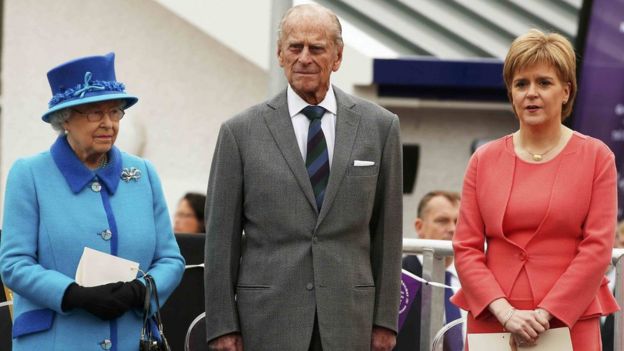


The Queen, the Duke of Edinburgh and Nicola SturgeonImage copyrightReuters

There have been glowing tributes and much talk about the significance of this moment. No such words were uttered by the subject of all the attention.
She undertook a run-of-the-mill engagement on a far from run-of-the-mill day. And in her brief remarks - her lengthy reign hasn't lessened her aversion to making speeches - she displayed some classic British understatement.


Overtaking her great-great-grandmother wasn't something she'd ever aspired to, she said. She was simply the beneficiary of a long life.
In Scotland - and indeed in other parts of the United Kingdom - that life and her reign have been celebrated very publicly.


Privately, later, the Queen will mark the moment she enters the record books. Prince Philip will be with her - her husband of 67 years has been the one constant in a reign of sometimes dizzying change.
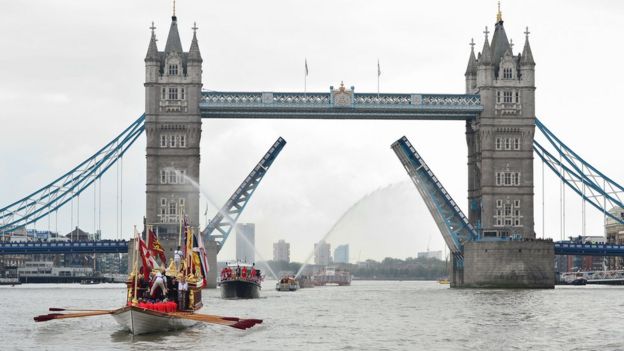


Flotilla ofImage copyrightPA
Image captionIn London, a flotilla of vessels, including Havengore and Gloriana, took part in a procession along the Thames
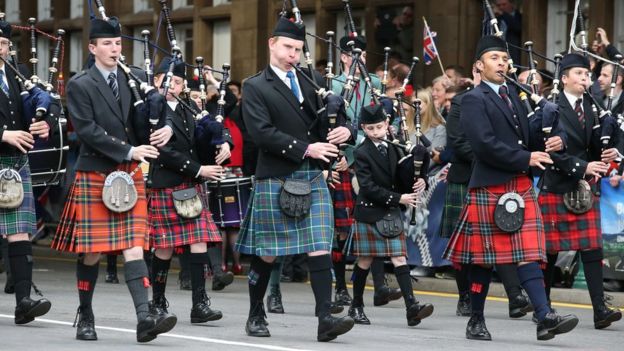
Pipe band greeting the QueenImage copyrightPA
Image captionMeanwhile, in Edinburgh, the Royal Party were welcomed by a traditional pipe band
Queen unveils a plaque at Newtongrange stationImage copyrightAFP
Image captionThe Queen and the Duke stopped off at Newtongrange station where she unveiled a plaque
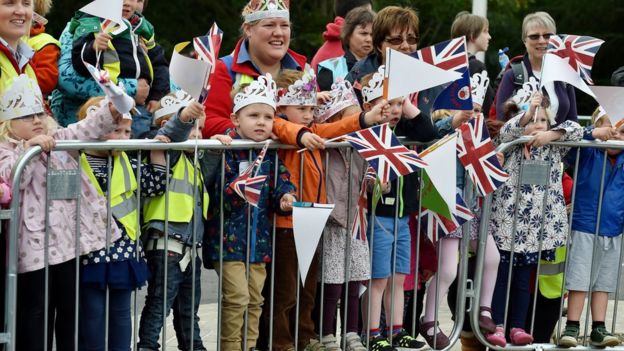
Children wait for the Queen in TweedbankImage copyrightPA
Image captionChildren from Busy Bees Nursery turned out to see the Queen in Tweedbank

Buckingham Palace has released two official photographs to mark the occasion, taken by Mary McCartney in the Queen's private audience room.
This is where she holds weekly audiences with prime ministers of the day, and receives visiting heads of state and government.
The Queen is taking her traditional summer break at this time of year at her private Scottish home, Balmoral.
The Duke and Duchess of Cambridge are in Scotland on holiday and are expected to have dinner with the Queen at Balmoral later.

Queens of the modern age
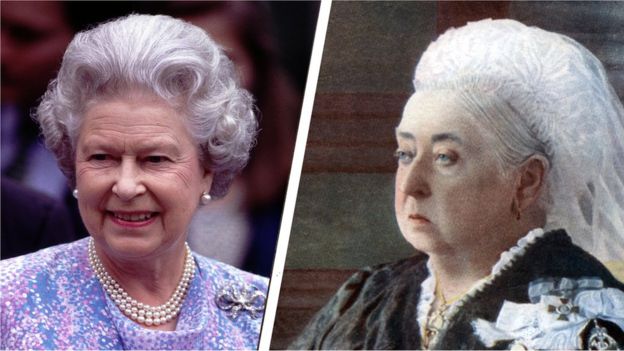


Queen Elizabeth and Queen VictoriaImage copyrightGetty Images
Image captionElizabeth II has reigned for 63 years and seven months, beating Queen Victoria's record

  • Victoria became queen at 18, while Elizabeth was 25
  • Elizabeth II rides in the same coach as Victoria did for the annual State Opening of Parliament
  • Both queens were shot at by lone gunmen while out riding near Buckingham Palace
  • Elizabeth loves the private royal estate at Balmoral, which was bought by Victoria
  • Victoria ruled over an empire of 400 million people. Elizabeth is head of state for 138 million people.

Queen Victoria became queen at the age of 18 and ruled for 63 years, seven months and two days.
Queen Elizabeth's reign has included 12 prime ministers, two more than served under Victoria.


'Genuinely exceptional'

The Queen is Head of the Commonwealth and sovereign of 15 Commonwealth realms in addition to the UK, and the organisation's Secretary-General, Kamalesh Sharma, sent his congratulations.
"As a symbol of continuity during decades of unprecedented change, and by drawing our people together in their rich diversity, Her Majesty has embodied all that is best in the Commonwealth," he said.
"With vision and dedication her example has encouraged successive generations of leaders and citizens to embrace the promise of the future."


Thursday, September 18, 2014

Scotland and Catalonia differences ( 2 )


If Catalonia holds a referendum on independence, it will likely look to Scotland as a guide. Scotland’s existence as an independent state ended in 1707, when the Scottish parliament entered into the Treaty of Union with England.The Treaty dissolved the Scottish parliament and transferred ultimate political authority to London. One Scottish parliamentarian of the time lamented that the day on which the Treaty was put to a vote in the Scottish parliament was “the last day Scotland was Scotland.”

But Scotland “entered the United Kingdom with a distinct institutional trajectory of its own,” and following the union it retained a robust civil society, including its own legal and educational systems, social welfare programs, and established the Presbyterian church. Scots also made significant contributions to the British Empire, which “did not dilute the sense of Scottish identity but strengthened it by powerfully reinforcing the sense of national esteem and demonstrating that the Scots were equal partners in the great imperial mission.”

Although Scottish culture and identity flourished in the United Kingdom and the Empire, Scottish nationalism as a political force largely lay dormant until the 1960s, when the SNP surprised the British establishment by winning a parliamentary by-election. The discovery of oil in the North Sea in 1970 led many nationalists to argue for greater Scottish control over its own resources and revenues and to claim that Scotland could survive economically as an independent state. Diverting the flow of North Sea oil revenues from London to Edinburgh remains a central plank in the SNP’s economic platform.

During the 1970s, in an effort to co-opt Scottish national sentiment and maintain its position as the dominant political party in Scotland, the Labour Party announced plans for the devolution of political authority to Scottish institutions, but its proposal failed to obtain a sufficient number of votes in a 1979 referendum. The issue of devolution was shelved during the 1980s and early 1990s, when the Conservative Party governed the United Kingdom. The Conservatives followed an unabashedly pro-Union line, which alienated many Scottish institutions accustomed to being afforded a wide berth by London and in turn increased Scottish support for autonomy.

When the Labour Party returned to power under Tony Blair in 1997, it promised devolution of powers throughout the United Kingdom, in part to“‘lance the boil’ of independence.” In 1998, the Labour government introduced the Scotland Act, which provided for the creation of a local Scottish parliament. In contrast to the failed devolution referendum of 1979, Scottish voters enthusiastically backed the Scotland Act, and in 1999 the first Scottish Parliament since 1707 met in Edinburgh. Ultimately, the Scotland Act formed part of a broader pattern of devolution that also resulted in the establishment of a Welsh Assembly and, under the terms of the Good Friday Agreement, a power-sharing government composed of unionists and nationalists in Northern Ireland.

Although the Labour Party initially controlled the devolved Scottish Parliament, in the 2007 elections the SNP cut deeply into Labour’s majority, and the SNP’s leader, Alex Salmond, became First Minister in an SNP-led minority government. The SNP’s decisive May 2011 victory pushed independence to the forefront of Scotland’s political agenda. On January 25, 2012, the birthday of the Scottish national poet Robert Burns, Salmond announced plans to hold a referendum on Scottish independence in the autumn of 2014, which would coincide with the 700th anniversary of the victory of Scottish forces over English invaders at the Battle of Bannockburn. The government of Prime Minister David Cameron came out forcefully in opposition to Scottish independence. Nonetheless, in the Edinburgh Agreement reached on October 15, 2012, the British government granted the Scottish Parliament authority to hold a referendum, and the two governments agreed to the ground rules for the referendum process.

Blog Archive